Based on an ethnographic study on motility and gendered work cultures, the paper sheds light on Serbian female domestic workers who commute (in the three months visa regime) between Germany and Serbia in order to perform care and domestic in the private households. The paper brings together the specific characteristics of irregular work and regular circular migration highlighting the specific position of Serbian care workers in German informal care market and necessity of better qualitative understanding of multiplicity of dimensions of social reality that shape migrant worker’s experiences and lives apart from gender – age, nationality, religion, different social and educational background and geopolitical location. Using the concept of “motility” – ability to move, paper explores individuals' capacities and skills that either directly or indirectly influence physical mobility, knowledge or the recognition for the need of knowledge on how to cross border and how to stay mobile which redirects our attention to the aspirations and lives of women who, despite myriad impediments, move between German cities and their home communities. The analysis of in-depth interviews shows that strategies these women use to be able to move for work (for example, building a socil networks, gaining a new skills, acquiring a knowledge about movement regulations, etc.) are a basis for understanding of women’s decisions and opportunities to move, as these constitute their everyday experiences and practices which are not marked only by risks but also by personal transformations.

Sunday, 27 May 2018

Friday, 25 May 2018
Rebecca Sebbagh presents a working paper on 'Rooted in Tradition? The Selection of Psalms in Jewish Liturgy'
This chapter is the basis for a lecture I will give in Modena at the symposium on"Tradition" at the 14
thof June.Too, this paper is the first draft of a bigger chapter in my project. The chapter in my project will address the choice of psalms in the Jewish liturgy. It will address the theological, literary and practical principles that led to their choice. In it, I will not only be addressing the psalms which recitation seems to be obvious – like the incipits of the psalms suggest Psalm 92 for Shabbat and Psalm 30 during Hanukka - but also the psalms for which the reason of choosing it in recitation is not entirely clear. For this, the literature will be examined and analyzed (rabbinic literature, prayer commentaries, exegesis of the bible, …).
Thursday, 24 May 2018
Alex George is going to present a working paper on 'Accessing Mobility and the Promises of Success in School: analysis of childhood memories'
Paper
focuses on a
selection of memories regarding childhood and youth of two
individuals who are
50 and 45 years old. The interviews focused on their everyday
life in school or
outside it with friends, family and work. Both of them belong
to rural
households and achieved some social mobility. The occupation
of their parents
and caste differed. Case 1 transitions from being a child
labour after becoming
a school dropout, and finally becoming a driver. His father
was a wage labourer
and of the OBC caste. Case 2 belongs to one of the Dalit
family clusters whose
intergenerational mobility is discussed elsewhere. He went to
the college for a
year, and marries the same year, takes up various jobs and
finally at age 42
gets a permanent job. His father was a first-generation
learner and amongst the
first in his family to move out of the traditional occupation
of hide/ leather
processing. Father was a Class IV employee in the government
sector who lived
in a village. Case 2’s father and Case 1 belong to the same
village. Majority
of Dalits and Adivasis who benefitted from government’s
reservation policy were
employed in the Class IV employment which largely involved
physical labour. Both
faced different challenges in growing up in the context of
schooling as
following: illiteracy of the parents; individual’s position in
the birth order
in the family; attitude of their teachers; presence or absence
of educational
infrastructure; limited exposure and information regarding
possible careers;
etc.
The
previous
research has analysed experiences of marginalisation in
various forms of life
narratives such as biographies, or autobiographies and
ethnographies. They recorded
the experiences of growing up in the context of caste
hierarchies, as child
labourers, daughters responsible for the care of siblings,
racial differences, etc.
Some of these research problematises the role of schooling in
enabling social
mobility. These analyses are useful in building an
understanding and locating
the memories collected through the life narratives interviews
for the current
research. By bringing together this selection of memories the
paper identifies
and compares differential access to school, social network and
experiences of
marginalisation, accessing their chances of gaining social
mobility
Wednesday, 23 May 2018
Meister Eckhart and the Church Fathers - First workshop of the joint French-German Project at Metz
On 16./17. May 2018, the two groups of French and German researchers met for their first workshop as part of the joint project, financed by the French ANR and the German DFG to explore the sources and traditions on which Meister Eckhart based his works.

The workshop questioned the anachronistic concepts of 'quotation' or 'citation', of 'reception' and 'transmission', as Eckhart shows an enormous variety of dealing with older traditions and authorities that can hardly been captured by the existing nomenclature. The project is run under the leadership of Marie-Ann Vannier (University of Lorraine, Metz) and Markus Vinzent (King's College London and Max-Weber-Kolleg, Erfurt).


The project that is running for three years will develop conceptual tools in understanding the different ways Eckhart appropriates and makes his own Patristic authorities, publish the papers of conferences, monographs on specific authors who have a particular importance in Eckhart (Origen, Augustine, Pseudo-Chrysostom, Jerome, Maximus Confessor, John of Damascus, Albertus Magnus) or for Eckhart (Nicolaus Cusanus and Henry Suso). Unfortunately, we do not have pictures of all speakers - so here the few snapshots:
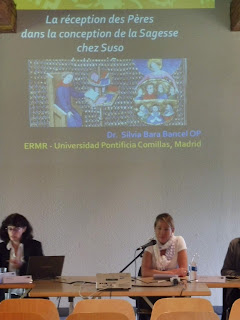


The project will also create the Patristic Index for the critical edition of Eckhart's works in the Kohlhammer edition (to follow the first volume of the Bibleindex, published by Loris Sturlese and Markus Vinzent in 2015).
And, of course, we celebrated being together with typical French conviviality (for which we thank the French team and the University of Lorraine for all their hard work, preparation, organisation and finance):


The project that is running for three years will develop conceptual tools in understanding the different ways Eckhart appropriates and makes his own Patristic authorities, publish the papers of conferences, monographs on specific authors who have a particular importance in Eckhart (Origen, Augustine, Pseudo-Chrysostom, Jerome, Maximus Confessor, John of Damascus, Albertus Magnus) or for Eckhart (Nicolaus Cusanus and Henry Suso). Unfortunately, we do not have pictures of all speakers - so here the few snapshots:

Silvia Bara Bancel (Université de Madrid) and Elisabeth Boncour (Université catholique de Lyon)

Jacques Elfassi (Université de Lorraine) on Eckhart and Isidore of Seville

Jana Ilnicka (mid) on Eckhart and Boethius

Dietmar Mieth on Eckhart and the tradition of action and contemplation

Jean-Claude Lagarrigue (ERMR Strasbourg) and Julie Casteigt (Université de Toulouse II)
The project will also create the Patristic Index for the critical edition of Eckhart's works in the Kohlhammer edition (to follow the first volume of the Bibleindex, published by Loris Sturlese and Markus Vinzent in 2015).
And, of course, we celebrated being together with typical French conviviality (for which we thank the French team and the University of Lorraine for all their hard work, preparation, organisation and finance):


Tuesday, 22 May 2018
Andreas Folkers gives a working paper on 'Logistical resistance: Operations of capital, corporate security and protest in supply chains and finance'
This paper investigates the conflictual constellation between protest movements and corporate security initiatives, in order to deepen the understanding of the political stakes of attempts to secure circulation. In recent years protest movements around the world have engaged in acts of logistical resistance in attempts to disrupt economic circulation. Corporate actors increasingly regard these movements as severe threats to their operations. Our paper will focus on the relationship between ‘logistical resistance’ and corporate security strategies, as a way of illuminating the hidden work of Business Continuity Management in finance and Supply Chain Security in logistics. In their own ways both security apparatuses are vital for contemporary capitalism by helping to safeguard, establish and maintain the connectivity between heterogeneous operations of capital. Logistical resistance targets this connectivity and thus becomes a risk for endeavours to secure circulation. We argue that the study of logistical resistance both makes visible the political stakes of security as a threat to democratic politics and shows the vulnerability and contingency of contemporary operations of capital. The paper provides a conceptual contribution to debates on the operations of capital, on corporate security and on logistical resistance as well as an analysis of particular cases: public protests in Frankfurt’s financial district that attempted to interrupt the banking business, attempts to block seaports in the context of Occupy Oakland, and demonstrations against the recent G20 summit in Hamburg.
Arthur Bueno is going to presents a working paper on 'Rationality – Cultivation – Vitality: Simmel on the Pathologies of Modern Culture'
This
paper reconstructs Georg Simmel’s writings on money and modernity with a view
to outlining a multi-layered diagnosis of the pathologies of modern culture. The resulting framework allows for the distinction of
three different perspectives, each of them based on a particular
anthropological philosophy and presenting a distinctive assessment of the
potentials and problematic features of modern life. In Simmel’s oeuvre, the
pathologies of culture are respectively understood as (1) irrational (from the
perspective of teleological action); (2) alienating (from the perspective of
subjective cultivation); and (3) mechanistic (from the perspective of
trans-subjective life).
Eleonore Schulz presents a working paper on 'Theologie des "Activ-Bürgers" - Der Freiheitsbegriff im Schwäbischen Magazin zur Beförderung der Aufklärung des Ulmer Theologen Johannes Kern'
The paper introduces Johannes Kern, protestant pastor and representative of enlightenment theology in Ulm. In addition to a brief biographical introduction and an overview of the social and political situation in Ulm at the end of the 18th century, references to the term freedom are contextualized and interpreted, which can be found in his journal "Schwäbisches Magazin zur Beförderung der Aufklärung". The references to the term freedom are presented in the context of Kern's overall argument in various articles and are interpreted in the context of his affiliation with a new bourgeois elite in the Reichsstadt. The concept of freedom is mentioned explicitly in Johannes Kern's journal articles in two contexts. First, freedom is a condition for human development and perfection, in the sense of a "trial and error" approach. However, this development is not open to results, but directed along continuous perfection. Second, Kern makes clear by using a description of "false freedom" that freedom is realized only in the perception of duty in the context of a meaningful social whole. This includes the acceptance of the social order and the individual position in this order. The freedom of God, the theologians had been busy with over so many centuries, vanishes implicitly. The order of nature, history and society is recognizable and manageable. The deficiencies of man serve his perfection, rather than putting him in need of the free divine decision of grace. The worldliness and controllability of salvation becomes particularly clear from the fact that arguments originally used to defend divine freedom in the relationship between man and God are now only used to defend social order. In the context of the reference to the term freedom it also gets clear that Kern is well aware of the contradiction between the universal demands of the Enlightenment and their particular fulfillment and that he searches for strategies to hide or balance this contradiction.
Subscribe to:
Posts (Atom)